


Solar Carports and Canopies for Colorado Businesses: Costs, ITC Adders and Code
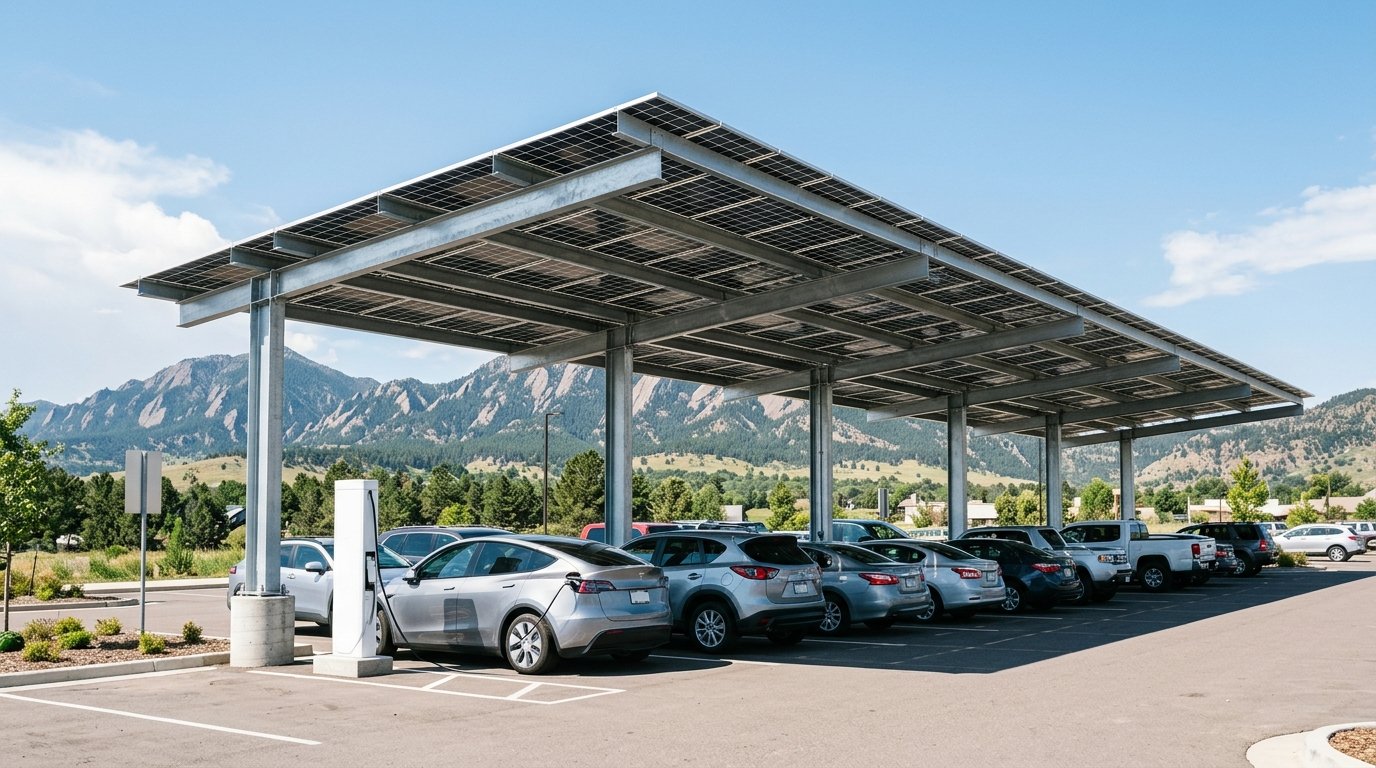
A commercial solar carport is one of the highest value moves a Colorado business with a big parking lot can make. A solar carport, sometimes called a solar canopy, is an elevated structure that holds photovoltaic panels above your parking spaces. It does three jobs at once: it generates clean power, it shades vehicles from Colorado sun and hail, and it creates the perfect mounting point for parking-lot solar paired with EV charging. For a property with acres of asphalt and a roof that is already crowded or aging, parking-lot solar often unlocks generation capacity that a rooftop alone never could.
At ProGreen Solar we design and build commercial solar across the Front Range and the Western Slope, and a solar carport sits in a sweet spot for warehouses, retail centers, offices, municipal lots and dealerships. Below we walk through what these structures cost, where they earn a stronger federal tax credit, and a real code advantage that elevated structures hold over rooftop arrays.
Why a solar carport makes sense for Colorado businesses
Most commercial buildings have a finite roof. Once you account for HVAC units, skylights, setbacks and structural limits, the usable roof area caps how much solar you can install. A parking lot, by contrast, is wide open. Building a solar canopy over it converts otherwise dead space into a generating asset while delivering benefits a rooftop system cannot.
- Covered parking: Employees and customers get shade in summer and protection from snow and hail load on their vehicles.
- Hail protection: In a hail-prone state, covered parking is a tangible perk that helps recruit and retain staff and draws customers.
- EV charging built in: The canopy structure gives you a clean, shaded place to mount and wire chargers, which we cover in our guide to EV charging and solar.
- Optimal orientation: Unlike a fixed roof plane, a carport can be engineered to face and tilt for ideal production.
- No roof penetrations: The array lives on its own steel structure, so you are not adding load or holes to an existing roof membrane.
What a solar carport costs
Be clear-eyed about the budget. A solar carport costs more per watt than a comparable rooftop system. You are paying for engineered steel columns, foundations, a canopy frame and the labor to erect it, none of which a rooftop array needs. The structure itself is the bulk of that premium.
That higher upfront cost is offset by the value a carport delivers that rooftop cannot: covered parking, hail protection, ideal tilt and a natural home for EV charging. For many businesses the question is not whether a carport pencils out against a rooftop on cost per watt alone. It is whether the parking-lot solar approach is the only practical way to reach the system size you actually need. When the roof is full, aging, or structurally limited, the carport is often the path to the capacity you want, and the covered-parking amenity comes along for free.
What drives the price
- Structure type: Single-column cantilever designs cost more than simpler T-frame or full-span layouts, but they maximize usable spaces underneath.
- Foundations: Soil conditions, frost depth and snow and wind loading all shape the foundation design, which matters across Colorado's varied terrain.
- Snow and wind loads: Mountain and foothill sites carry heavier engineering than Eastern Plains lots.
- Electrical run: Distance from the canopy to your main service and whether a main panel or service upgrade is required.
- EV charging scope: The number and type of chargers you add under the canopy.
The ITC adder advantage: more domestic content per watt
Commercial solar qualifies for the federal Investment Tax Credit, and on top of the base credit there are stackable bonus adders, including one for domestic content. Here is where a solar carport quietly shines. The bonus is measured against the cost of the project, and a carport carries a large amount of structural steel. Domestically produced steel is widely available, and because the steel makes up a meaningful share of a carport's total cost, the structure can help a project reach the domestic content threshold and capture that adder more readily than a lighter rooftop system might.
In other words, the same structural steel that makes a carport cost more per watt can also help that project earn a larger domestic-content bonus per watt. The adders are technical and the rules evolve, so the specific credit amount and eligibility should always be confirmed with your tax advisor for your project. For a fuller picture of how commercial incentives, financing and depreciation fit together, see our overview of commercial solar in Colorado.
The code advantage: rapid shutdown and elevated structures
There is a genuine electrical-code benefit to going elevated rather than rooftop. The 2023 National Electrical Code requires rapid shutdown for photovoltaic systems on or in buildings under NEC 690.12, a rule meant to de-energize conductors quickly so first responders can work safely on a building's roof. Ground-mounted and elevated structures such as solar carports that are not on a building are generally not subject to that rapid-shutdown requirement.
That distinction can simplify the system design and the equipment list, because the array is not sitting on an occupied structure. As a licensed Colorado electrical contractor, EC.0101788, ProGreen designs every commercial system to the code your local authority enforces, and the elevated nature of a carport is one of the design factors we weigh against the higher structural cost. The same logic that exempts a carport from rooftop rapid-shutdown rules is part of why ground and elevated mounts behave differently throughout the code.
Carports and fleet EV charging: a natural pair
If your business runs vehicles or wants to offer charging to staff and customers, a solar carport and EV charging belong together. The canopy provides shade over the chargers and the parked vehicles, the structure carries the conduit and equipment cleanly, and the solar overhead helps power the charging during the day. Fleets, dealerships, hotels, grocery anchors and workplaces all fit this model well. Pairing generation with charging under one structure also concentrates your electrical infrastructure in one place, which can streamline the interconnection and the service work.
How a carport compares to other commercial solar approaches
A solar carport is not the only way to add commercial capacity on land you already control. Some businesses with open acreage explore ground mounts or even agrivoltaics, which combines solar with farming or grazing. The right answer depends on what land or parking you have, your roof condition, your load profile and your charging plans. A parking lot that sits empty in the sun all day is often the most overlooked asset on a commercial property, and a carport is the cleanest way to put it to work without giving up the parking itself.
Is a solar carport right for your property?
A solar carport earns its keep when you have substantial parking, a roof that cannot host the system size you need, an interest in covered parking and hail protection, and a plan for EV charging. It costs more per watt than rooftop, but it delivers value rooftop cannot and can capture a stronger domestic-content adder per watt while sidestepping rooftop rapid-shutdown requirements.
ProGreen Solar designs, engineers and builds commercial solar carports and canopies across Colorado, from Front Range business parks to Western Slope facilities, and we coordinate the structure, the array, the EV charging and the electrical work as one project. If you want to know whether your parking lot pencils out, reach out through our commercial solar page and we will model the structure, the production and the incentives for your specific site.
Frequently Asked Questions
What is the difference between a solar carport and a solar canopy?
The terms are used interchangeably. Both describe an elevated structure that holds solar panels above parking spaces, generating power while providing covered parking underneath. Some people use canopy for designs over walkways or plazas and carport for parking lots, but functionally they are the same type of structure.
Does a solar carport cost more than rooftop solar?
Yes. A carport costs more per watt than a comparable rooftop system because you are paying for engineered steel columns, foundations and the canopy frame that a rooftop array does not require. That premium is offset by benefits rooftop cannot deliver, such as covered parking, hail protection, ideal panel orientation and a built-in place to mount EV chargers.
Why do solar carports qualify for the domestic content bonus more easily?
The domestic content bonus adder is measured against project cost, and a carport contains a large amount of structural steel. Because domestically produced steel is widely available and makes up a meaningful share of a carport's total cost, the structure can help a project reach the threshold for that adder. Confirm eligibility and the exact credit amount with your tax advisor.
Do solar carports need rapid shutdown like rooftop systems?
Generally no. The 2023 National Electrical Code requires rapid shutdown under NEC 690.12 for photovoltaic systems on or in buildings. Elevated and ground-mounted structures such as solar carports that are not on a building are typically not subject to that requirement, which can simplify the design. Your local authority having jurisdiction makes the final call.
Can I add EV charging to a solar carport?
Yes, and the two pair naturally. The canopy shades the chargers and the parked vehicles, the structure carries the conduit and equipment cleanly, and the solar overhead helps power charging during the day. This makes carports a strong fit for fleets, workplaces, hotels, dealerships and retail centers.
Does ProGreen Solar build commercial solar carports across Colorado?
Yes. ProGreen Solar designs, engineers and builds commercial solar carports and canopies across the Front Range and the Western Slope. As a licensed Colorado electrical contractor, EC.0101788, we coordinate the structure, the array, the EV charging and the electrical work as a single project.
Ready to Go Solar?
Get a free personalized quote from ProGreen Solar, Colorado's most trusted installer.
Get a Free Quote