


Domestic Content Bonus Credit: Adding 10% to Your Commercial Solar ITC
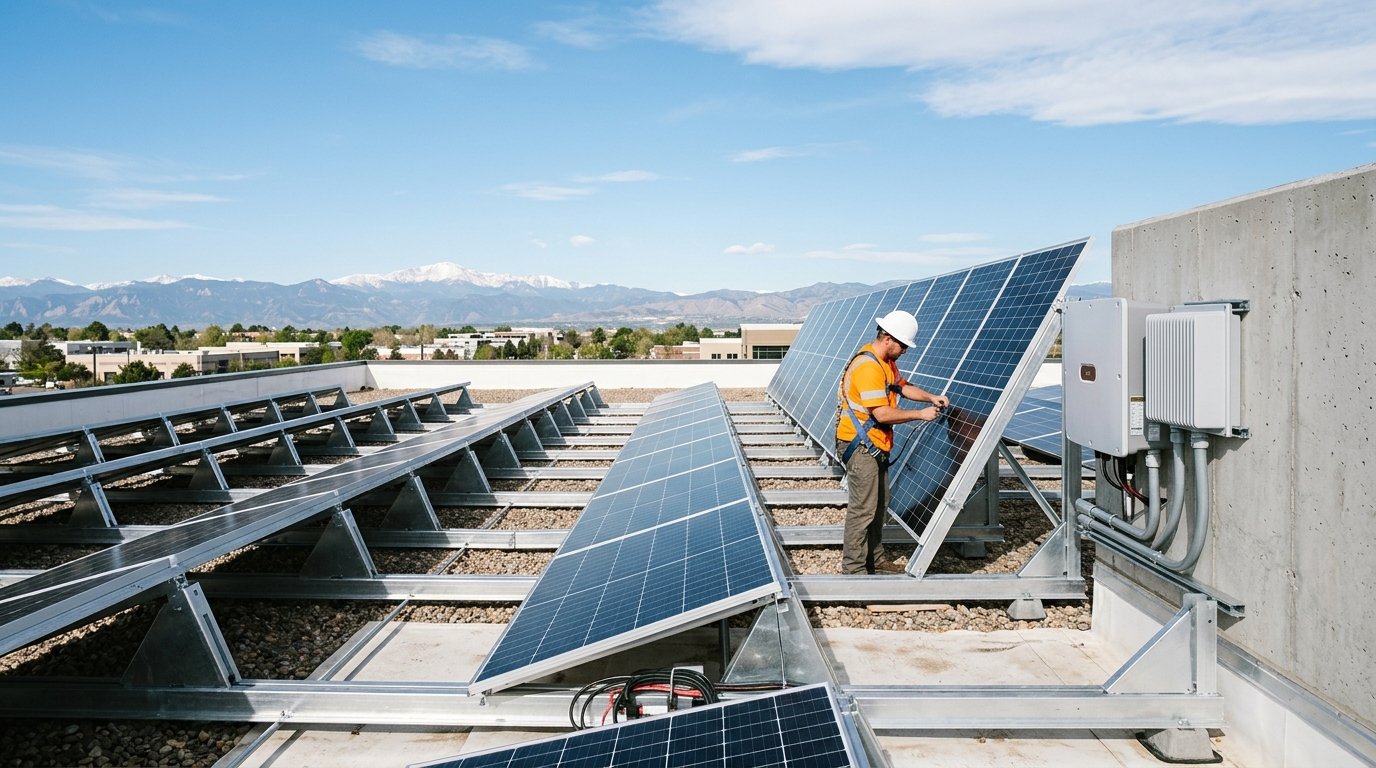
Short answer: The domestic content bonus solar credit adds 10 percentage points to the federal Section 48E Investment Tax Credit when a commercial solar project uses enough U.S. made steel, iron, and manufactured products. Stacked on the 30 percent base credit, it lifts a qualifying project to a 40 percent federal credit, and if the project also sits in an energy community it can reach 50 percent. For a Colorado business building solar in 2026, the domestic content bonus is real money on the table, but it comes with a rising threshold and specific paperwork.
This guide explains what the domestic content bonus is, how the two compliance paths work, what the 50 percent threshold for 2026 projects means, and how a commercial owner on the Front Range or Western Slope actually captures the extra 10 percent. If you are weighing a commercial system, start with our overview of the Section 48E commercial solar tax credit, then come back here for the bonus mechanics.
What is the domestic content bonus for solar?
The domestic content bonus is one of two stackable adders that sit on top of the Section 48E base credit. It rewards projects that buy American. Specifically, a project earns the bonus when its steel and iron components are made in the United States and a required percentage of the cost of its manufactured products, such as solar modules and inverters, is attributable to U.S. manufacturing.
The bonus is worth a full 10 percentage points added to your ITC rate. On a project that already qualifies for the 30 percent base credit, the domestic content bonus brings the federal credit to 40 percent of eligible cost. It is a separate determination from the energy community bonus, and the two stack, which is how a well planned Colorado project can reach a 50 percent total credit.
The IRS spelled out the rules in a series of guidance documents, most recently Notice 2025-08, which updated the elective safe harbor and the cost percentages installers use to certify compliance. Because this is tax guidance that continues to evolve, treat the figures here as a planning framework and confirm the specifics for your project with a qualified tax advisor.
The two requirements: steel and iron, plus manufactured products
Domestic content is tested in two parts, and a project has to satisfy both.
- Steel and iron requirement. All structural steel and iron in the project, think racking, ground mount posts, and structural fasteners, must be manufactured in the United States. This is an all or nothing test for those specific components. The metallurgical processes, from melting through coating, generally need to occur domestically.
- Manufactured products requirement. A required percentage of the total cost of the manufactured products, including solar modules, inverters, and similar equipment, must come from U.S. manufacturing. This is the percentage based test, and it is the one that rises over time.
Most of the planning effort goes into the manufactured products test, because that is where module and inverter sourcing decisions live. The steel and iron test is usually satisfied by choosing domestic racking, which is widely available.
It helps to understand why the test is split this way. Steel and iron are commodity structural inputs where domestic supply is mature, so the rule simply demands they be made here. Manufactured products are more complex assemblies with global supply chains, so the rule measures them by cost share rather than demanding every piece be domestic. That cost share is calculated across the manufactured products as a group, not component by component, which gives you some flexibility: a project can include an imported part and still qualify if enough of the total manufactured products cost comes from U.S. production. Knowing this lets you target the highest cost items, usually the modules, for domestic sourcing first.
The rising threshold: 50 percent for projects beginning construction in 2026
The manufactured products percentage, often called the adjusted percentage, is not fixed. It ratchets up based on the year a project begins construction, which pushes the supply chain toward more domestic content over time. For projects that begin construction in 2026, the threshold rises to 50 percent. In other words, at least half of the manufactured products cost in your project must be attributable to U.S. manufacturing to claim the bonus.
This matters for timing. The year you begin construction sets the threshold you have to hit, and beginning construction is also the test that governs your underlying 48E credit and its July 4, 2026 deadline. Two different rules key off the same begin construction date, so the procurement and the construction timeline have to be planned together. A project that locks in domestic equipment and begins construction in 2026 is held to the 50 percent threshold, not a future, higher one.
Two ways to prove domestic content
The IRS gives commercial owners and installers two compliance paths to demonstrate that a project meets the manufactured products threshold. You pick the one that fits your documentation.
Path 1: the direct cost method
Under the direct cost method, you calculate the actual share of manufactured products cost that comes from U.S. production, using real manufacturer cost data. This is the precise approach, but it depends on suppliers disclosing detailed, often confidential, cost breakdowns of their products. Many manufacturers are reluctant to hand over that data, which historically made this path hard to use.
Path 2: the safe harbor tables
To solve the data problem, the IRS published an elective safe harbor with cost tables, updated in Notice 2025-08, that assign default cost percentages to common solar components. Instead of chasing confidential supplier data, you classify each component by where it was made and apply the table values to determine whether you clear the threshold. The safe harbor tables are the practical path for most commercial projects because they let you certify compliance using published figures rather than negotiated disclosures.
Whichever path you use, documentation is everything. A defensible domestic content claim is built on supplier certifications, bills of materials, and a clear calculation tied to the method you chose. This is paperwork your installer and tax advisor should assemble during procurement, not after the project is energized.
One more practical note on the safe harbor: it classifies components by category, so you need to map each item in your design to the right table entry and then confirm, with supplier documentation, where that specific unit was actually manufactured. A module line from a manufacturer that operates several plants may be domestic from one facility and imported from another, so the model number and plant of origin both matter. Build a component list early, request manufacturing origin certifications in writing, and keep them with the project file. If you are ever asked to substantiate the claim, that file is what protects the credit.
How tariffs and sourcing interact with the bonus
Domestic content does not exist in a vacuum. The same trade policies that shape solar equipment prices also shape which products can credibly count as U.S. made. Tariffs on imported cells and modules have pushed more module assembly onshore, which expands the menu of equipment that can help you hit the threshold, though pricing and availability shift constantly. We cover the trade landscape in our explainer on solar tariffs and what they mean for buyers. The short version for a domestic content claim: confirm the manufacturing origin of every major component with current supplier documentation, because country of brand is not the same as country of manufacture.
Stacking the domestic content and energy community bonuses
The domestic content bonus is most powerful when it is paired with the other 10 point adder. If your project both uses qualifying domestic content and sits in a qualifying energy community, the two bonuses stack on the 30 percent base for a 50 percent total federal credit. Colorado has several qualifying energy community locations, including coal closure areas, so this stack is genuinely achievable here. We walk through the location test in our guide to the energy community bonus credit in Colorado.
Domestic content also shares conceptual ground with the foreign sourcing restrictions that now apply to commercial solar. Both push projects toward verified, traceable supply chains, though they are separate rules with separate tests. If your project is navigating the newer foreign entity limits, see our breakdown of the material assistance cost ratio so you can plan procurement against both sets of rules at once.
Is the bonus worth chasing?
For most commercial projects, yes, but with eyes open. An extra 10 percentage points of credit is a meaningful return, often tens of thousands of dollars on a mid sized commercial array. The tradeoff is that domestic equipment can carry a price premium and a narrower product selection, and the documentation burden is real. The right answer depends on your project size, the price delta on qualifying equipment, and whether you can also capture the energy community bonus to make the domestic supply chain effort go further.
A practical rule of thumb: if domestic equipment is reasonably priced and available for your design, the 10 point bonus almost always outweighs the premium. When the premium is steep or the products you need are not available domestically, the math can flip. This is a project specific calculation, and it should be run before equipment is ordered, not assumed.
How ProGreen approaches domestic content in Colorado
At ProGreen Solar, we scope commercial projects across the Front Range and Western Slope with the federal bonuses built into the equipment plan from the start. That means selecting racking, modules, and inverters with their manufacturing origin and safe harbor classification in mind, assembling the supplier certifications during procurement, and modeling whether the domestic content premium pencils out for your specific site and credit position. As a licensed Colorado electrical contractor, EC.0101788, we coordinate the technical install and the documentation trail together so the bonus claim rests on real, traceable records.
If you are planning a commercial system and want to know whether the domestic content bonus is within reach for your equipment and budget, learn more about commercial solar with ProGreen. We will help you weigh the supply chain options against the credit upside before anything is ordered.
The bottom line
The domestic content bonus solar credit adds 10 percentage points to the Section 48E ITC, lifting a qualifying commercial project from 30 to 40 percent, or to 50 percent when stacked with the energy community bonus. To earn it, a project must use domestic steel and iron and clear a manufactured products threshold that rises to 50 percent for construction beginning in 2026, proven either through the direct cost method or the IRS safe harbor cost tables under Notice 2025-08. For a Colorado business, it is a substantial incentive worth designing for, provided the equipment is available and the documentation is built during procurement. Confirm the current rules and your eligibility with a qualified tax advisor before you commit.
Frequently Asked Questions
How much is the domestic content bonus for solar?
The domestic content bonus adds 10 percentage points to the Section 48E Investment Tax Credit. On a project that already qualifies for the 30 percent base credit, it raises the federal credit to 40 percent of eligible cost. Stacked with the energy community bonus, a project can reach a 50 percent total federal credit.
What are the two requirements to qualify for the domestic content bonus?
A project must meet two tests. First, all structural steel and iron, such as racking and ground mount posts, must be manufactured in the United States. Second, a required percentage of the cost of the manufactured products, including modules and inverters, must come from U.S. manufacturing. Both tests have to be satisfied.
What is the domestic content threshold for 2026 projects?
The manufactured products percentage rises based on the year construction begins. For projects that begin construction in 2026, the threshold is 50 percent, meaning at least half of the manufactured products cost must be attributable to U.S. manufacturing. Confirm the current figure with a qualified tax advisor.
How do I prove a project meets domestic content rules?
There are two compliance paths. The direct cost method uses actual manufacturer cost data to calculate the domestic share, which requires detailed supplier disclosures. The safe harbor method uses IRS published cost tables, updated in Notice 2025-08, that assign default percentages to common components. Most commercial projects use the safe harbor tables because they rely on published figures rather than confidential supplier data.
Is the domestic content bonus worth the extra equipment cost?
Often yes. An extra 10 percentage points of credit can be worth tens of thousands of dollars on a commercial array. The tradeoff is that domestic equipment can carry a price premium and narrower selection. When qualifying equipment is reasonably priced and available, the bonus usually outweighs the premium. Run the calculation for your specific project before ordering.
Can I combine the domestic content bonus with other solar incentives?
Yes. The domestic content bonus stacks with the energy community bonus, so a qualifying Colorado project can reach a 50 percent federal credit. It also works alongside accelerated depreciation and Colorado state and utility incentives. The bonuses are separate determinations, so a project can earn one, both, or neither depending on equipment and location.
Disclaimer: This article is general information, not tax or legal advice. Tax credits, deadlines, and IRS guidance change frequently and depend on your specific situation. Consult a qualified tax advisor or attorney before acting. Accurate as of June 24, 2026.
Ready to Go Solar?
Get a free personalized quote from ProGreen Solar, Colorado's most trusted installer.
Get a Free Quote