


5% Safe Harbor vs. Physical Work Test: Two Ways to Lock In the Solar ITC
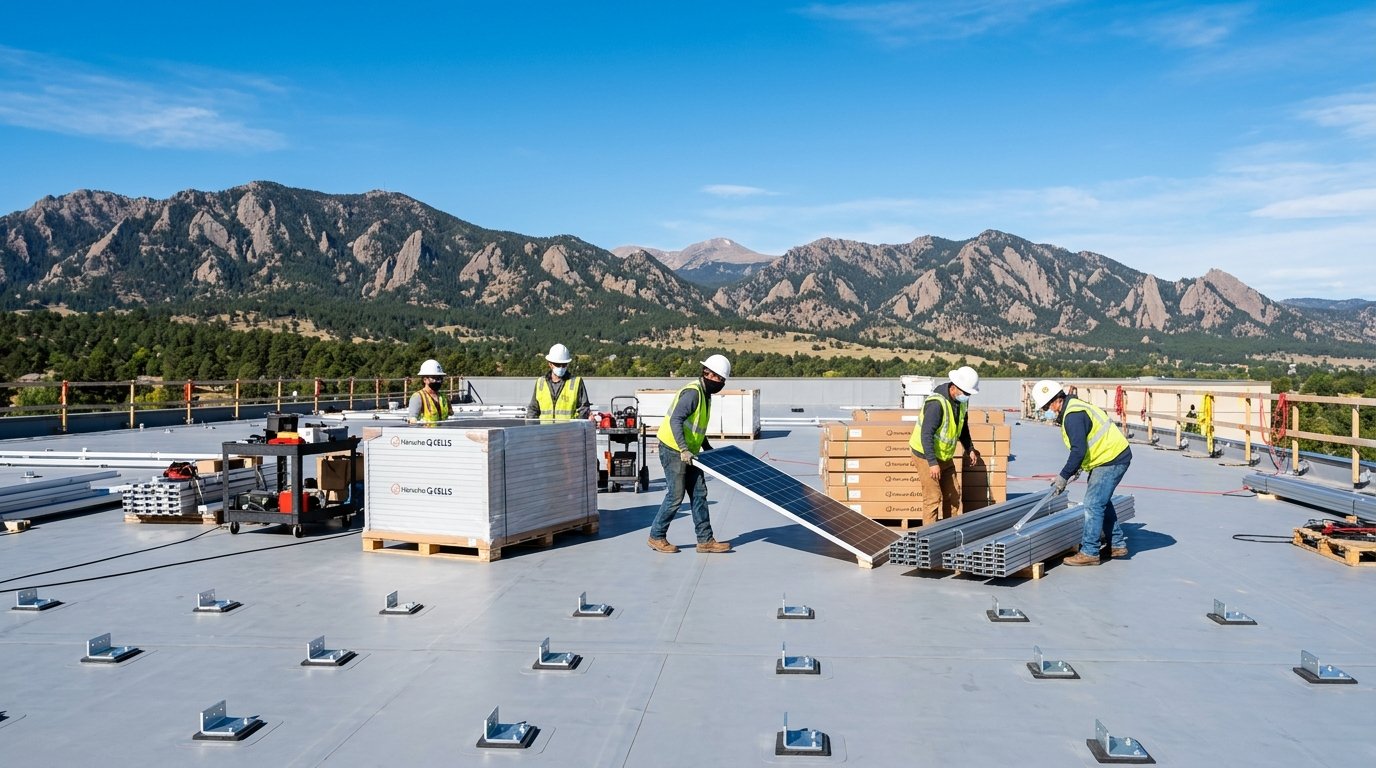
If your Colorado business wants to keep the 30% Section 48E commercial solar ITC, you have to begin construction on the project on or before July 4, 2026. The IRS recognizes two ways to prove you did that: the solar 5% safe harbor and the physical work test. Hit either one and your project is treated as having started, even if the panels do not actually go up until later. This post explains how each method works, what counts, and how the two compare so you can pick the path that fits your project.
We work with both methods on commercial jobs across the Front Range and the Western Slope, and as a licensed Colorado electrical contractor (EC.0101788) we handle the on-site work that the physical work test depends on. Here is the plain-English version of what the rules ask of you.
Why begin construction matters at all
The Section 48E Clean Electricity Investment Credit is worth a base 30% of eligible project cost, and the deadlines that govern it turn on when a project begins construction, not when it switches on. Under current law a commercial solar project generally keeps the full 30% credit if it begins construction on or before July 4, 2026, or alternatively is placed in service by December 31, 2027. For the background on the deadline itself, see our guide to the solar safe harbor deadline in 2026, and for how the credit is structured see our explainer on the Section 48E tax credit for commercial solar.
Because real solar projects take months to design, permit, procure, and build, the IRS lets you nail down your start date earlier than your finish date. That is the entire purpose of the two begin-construction methods. You establish a defensible start, then you have a multi-year window to finish under the continuity rules. The two methods are not better or worse in the abstract; they are different tools for different situations.
The solar 5% safe harbor: pay or incur 5% of cost
The solar 5% safe harbor is the financial path. You begin construction by paying or incurring at least 5% of the total project cost before the deadline. Total cost here means the full cost of the energy property, the panels, inverters, racking, and other eligible equipment and installation, not just the part you have spent so far. If you incur 5% of that total, you are treated as having begun construction on the whole facility.
The word incur is doing real work in that sentence. For accrual-method taxpayers, a cost is generally incurred when the equipment is delivered or when economic performance otherwise occurs, not simply when you sign a purchase order. A common way businesses meet the safe harbor is by pre-buying equipment, or by making a payment under a binding written contract where title and delivery follow within a defined window. The mechanics of documenting a 5% spend, including binding contracts, title transfer, and inventory records, are worth getting right, and they are the focus of our companion equipment pre-buy guidance.
A few features make the 5% safe harbor attractive for many commercial buyers:
- It is objective. Either you incurred 5% of cost on time, or you did not. There is far less judgment involved than in evaluating whether physical work was significant.
- It does not require crews on the roof. You can lock in your start with a purchase and delivery, which is useful when permitting or interconnection is still pending.
- It scales cleanly to single-project and inventory-style procurement, as long as your documentation ties the cost to the specific facility.
One detail trips up taxpayers who think a deposit alone gets them across the line. For accrual-method businesses, a cash prepayment by itself usually does not count as an incurred cost. There is a limited exception, sometimes called the 3.5-month rule, under which a payment can be treated as incurred if you reasonably expect delivery within roughly three and a half months of paying. That window is one reason timing your purchases against the deadline matters as much as the dollar amount. Work the calendar backward from July 4, 2026 with your accountant so a delivery date does not undo an otherwise valid spend.
The main risk to watch is the cost overrun. If your project cost rises after you safe harbor and the amount you incurred slips below 5% of the new, higher total, you can fall short. Build in a cushion above 5% so a change order does not quietly disqualify you.
What the 5% method does not require
You do not need to break ground, mount equipment, or perform any physical labor to use the 5% safe harbor. That is precisely the point. It is a procurement and accounting test, which is why it is popular for projects that are financially committed but not yet shovel-ready.
The physical work test: work of a significant nature
The physical work test is the construction path. You begin construction by starting physical work of a significant nature, either on site or off site at a factory building components specifically for your project. There is no dollar threshold here. What matters is the nature of the work, not its cost or the percentage of the budget it represents.
On-site activities that have historically counted include things like installing racking or mounting structures, setting anchors and ground-mount footings, pouring foundations or pads for equipment, and beginning the physical installation of the array. Off-site, the test can be met by the manufacture of components built to your specification under a binding contract, for example transformers or custom racking made for your facility rather than pulled from stock inventory.
Two cautions apply. First, certain preliminary activities do not count as significant physical work. Clearing a site, removing existing structures, surveying, soil testing, and securing permits are generally treated as preliminary, not as the start of construction. Second, work performed under a binding written contract before the equipment or services are provided to you, and work on inventory items not tied to your project, generally will not establish your start. The work has to be real, significant, and connected to your specific facility.
It also helps to understand why the IRS draws the line where it does. The physical work test is meant to reward genuine construction activity, not paper gestures. That is why a custom transformer being built to your facility's specification can qualify, while pulling a stock inverter off a warehouse shelf does not. It is why driving footings into the ground for a ground mount can qualify, while grading the lot beforehand does not. When you plan a physical-work start, focus on the first activity that is both significant and uniquely tied to your system, and make sure your contractor records it cleanly. As a licensed Colorado electrical contractor, we can document the start of installation work, including dated photos and crew logs, so the record exists when it is needed.
When the physical work test fits
The physical work test shines when your project is genuinely ready to build but you do not want to commit 5% of the budget in cash up front, or when a manufacturer is already fabricating custom components for you. For a fully permitted ground-mount with footings going in, beginning real installation work can be a clean way to start construction. The tradeoff is that significant-work questions are more fact-intensive than a 5% calculation, so documentation matters even more.
Continuity: starting is not the whole story
Both methods carry a continuity requirement. After you begin construction, you are expected to make continuous progress toward completion. The IRS provides a continuity safe harbor that is satisfied if the project is placed in service within a set number of years after the year construction began, which removes the need to prove continuous effort on a case-by-case basis. In practical terms, beginning construction in 2026 and finishing within that multi-year window keeps you on solid footing. We cover the timing mechanics in more detail in our continuity safe harbor material, but the takeaway is simple: pick a method, document your start, and then keep the project moving.
The legal status you should know about
There is an important development that affects how the begin-construction rules are being administered, and any honest discussion needs to flag it. On June 6, 2026, the U.S. District Court for the District of Columbia, in Oregon Environmental Council v. IRS (No. 1:25-cv-04400-CKK), vacated IRS Notice 2025-42 in full, finding it arbitrary and capricious under the Administrative Procedure Act, which restored the 5% safe harbor. The court itself noted that the appellate timeline will almost certainly extend past the July 4, 2026 deadline.
This is current as of June 24, 2026, and it is exactly the kind of issue that can shift on appeal. Treat the legal landscape as unsettled, not as a settled guarantee, and confirm the rules in force with your tax advisor before you commit to a strategy. We are an installer, not a tax authority. What we can tell you is how each method works mechanically; what your advisor should tell you is which method is safest for your facts at the moment you act.
Choosing a method for your Colorado project
For most commercial buyers the decision comes down to readiness and cash position:
- Project is financially committed but not shovel-ready. The 5% safe harbor usually fits best. Pre-buy or pay or incur 5% of total cost, with a cushion, and lock your start without crews on site.
- Project is permitted and ready to build now. The physical work test can be a natural fit, especially for ground mounts where footings and racking are about to go in, or where a manufacturer is fabricating custom components for you.
- Either could work. Many teams favor the 5% method for its objectivity, then keep the project moving to satisfy continuity. The cleaner your records, the easier your eventual filing.
Whichever path you choose, documentation is the through-line. Keep your binding contracts, invoices, delivery records, payment proof, and dated photos of any on-site work. Tie every cost and every activity to the specific facility. A well-documented start is what makes the credit defensible years later.
ProGreen Solar builds commercial solar across Colorado, from Front Range warehouses and rooftops to Western Slope facilities, and we coordinate procurement, permitting, and installation timelines around your begin-construction strategy. If you want help mapping a 5% safe harbor or physical work test plan to your project, learn more about our commercial solar work in Colorado or read our broader overview of the federal solar tax credit. When you are ready to talk through a specific building and timeline, we can walk you through both methods and help you and your tax advisor pick the right one.
Frequently Asked Questions
What is the solar 5% safe harbor?
It is one of two IRS ways to begin construction on a commercial solar project. You pay or incur at least 5% of the total project cost before the deadline, and the project is then treated as having begun construction. It is a procurement and accounting test, so it does not require any physical work on site.
How is the physical work test different from the 5% safe harbor?
The physical work test asks whether you have started physical work of a significant nature, either on site or off site fabricating custom components for your project. There is no dollar threshold. The 5% safe harbor is purely financial and asks only whether you incurred 5% of total cost. The physical work test is more fact-intensive to document.
Why does begin construction matter for the Section 48E credit?
The deadlines that govern the 30% Section 48E commercial solar credit turn on when a project begins construction. A commercial project generally keeps the full 30% credit if it begins construction on or before July 4, 2026, or is placed in service by December 31, 2027. Establishing a start date earlier gives you a multi-year window to finish.
Do I need crews on my roof to use the 5% safe harbor?
No. The 5% safe harbor is met by paying or incurring 5% of total project cost, often through pre-buying equipment under a binding contract with delivery. No physical installation is required to establish your start under this method.
What happened with IRS Notice 2025-42?
On June 6, 2026, the U.S. District Court for the District of Columbia, in Oregon Environmental Council v. IRS, vacated Notice 2025-42 in full as arbitrary and capricious under the Administrative Procedure Act, which restored the 5% safe harbor. The court noted the appellate timeline will almost certainly extend past the July 4, 2026 deadline. This is current as of June 24, 2026 and could change on appeal, so confirm the rules in force with your tax advisor.
What records should I keep to prove I began construction?
Keep binding contracts, invoices, payment proof, and delivery records for the 5% method, and dated photos plus contractor records of any significant on-site or custom fabrication work for the physical work test. Tie every cost and activity to the specific facility so the credit is defensible when you file.
Disclaimer: This article is general information, not tax or legal advice. Tax credits, deadlines, and IRS guidance change frequently and depend on your specific situation. Consult a qualified tax advisor or attorney before acting. Accurate as of June 24, 2026.
Ready to Go Solar?
Get a free personalized quote from ProGreen Solar, Colorado's most trusted installer.
Get a Free Quote