


FEOC Compliance for Solar: Prohibited Foreign Entity Rules Made Simple
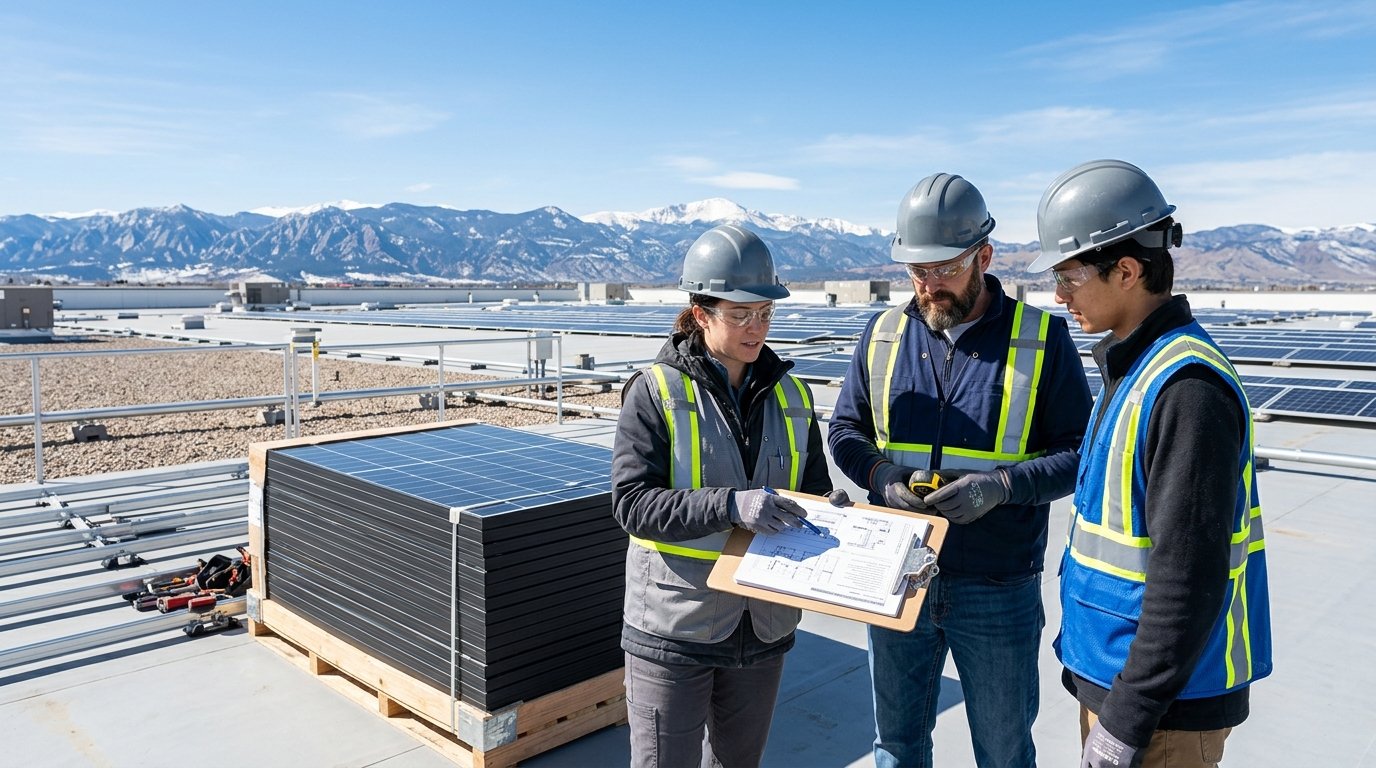
Short answer: FEOC solar compliance means structuring your commercial solar project so it avoids prohibited foreign entity involvement and does not receive disqualifying material assistance from those entities. Get it wrong and you can lose the Section 48E credit that anchors your project economics. These rules came out of the 2025 budget law and are governed by interim IRS guidance, so as of mid 2026 they are still being written. This guide explains what FEOC means, who counts as a prohibited entity, how the material assistance test works, and what a Colorado business should do now.
If you own a warehouse, dealership, farm, or office building anywhere from the Front Range to the Western Slope and you are planning commercial solar, FEOC solar compliance is the newest layer on top of the federal credit. It is also the layer most likely to trip up a project that looks otherwise solid. Here is how to think about it without the jargon.
What FEOC solar compliance actually means
FEOC stands for Foreign Entity of Concern, often referred to in the solar context as a prohibited foreign entity. The One Big Beautiful Bill Act, the 2025 budget legislation, added restrictions that tie federal clean energy credits to the origin of the people, money, and equipment behind a project. The core idea is simple: Congress wants the Section 48E credit to fund clean energy that is not dependent on certain foreign adversary linked entities, primarily those connected to China, Russia, Iran, and North Korea.
For a commercial solar buyer, FEOC compliance breaks into two practical questions:
- Is the project owned or controlled by a prohibited foreign entity? Direct ownership, control, or significant influence by a prohibited entity can disqualify the project outright.
- Does the project receive too much material assistance from prohibited entities? This is the supply chain question, and it is where most ordinary commercial projects will actually feel the rules through the equipment they buy.
If you are still getting oriented on the credit itself, start with our explainer on the Section 48E tax credit for commercial solar, then come back here. FEOC is a condition on that credit, not a separate program.
Who is a prohibited foreign entity?
The rules draw on definitions used elsewhere in federal law, including specified foreign entities and foreign influenced entities. In plain terms, a prohibited foreign entity generally includes:
- Entities owned by, controlled by, or organized under the laws of a covered foreign adversary nation.
- Companies in which such entities hold significant ownership or control.
- Entities subject to certain licensing, debt, or contractual arrangements that give a prohibited entity effective influence.
For most Colorado business owners, the takeaway is that your own company is almost certainly not a prohibited foreign entity. The risk does not usually live in who owns your building. It lives in the supply chain behind the panels, inverters, and batteries you install. That is why the material assistance test matters most.
The material assistance test, in plain English
Material assistance is the mechanism that pulls the supply chain into FEOC solar compliance. The concept measures how much of your project's manufactured components and materials trace back to prohibited foreign entities. If too much of the value comes from those sources, the project fails the test and loses eligibility for the credit.
The measurement is expressed as a cost ratio. You compare the cost of components that are free from prohibited foreign entity sourcing against the total cost of the relevant components, and that ratio has to clear a minimum threshold. The higher the share of compliant, non prohibited content, the safer the project. We break down the arithmetic and the specific percentage in our companion guide to the material assistance cost ratio, which is the number commercial buyers actually have to hit.
A few practical points worth understanding now:
- It is about cost, not country of final assembly. Where a panel is snapped together is less important than where the value inside it originates.
- The threshold tightens over time. Projects that begin construction in later years generally face stricter requirements than those starting earlier, so timing interacts with sourcing.
- Documentation is the deliverable. Passing the test is one thing. Being able to prove you passed it, with manufacturer certifications and a defensible cost calculation, is what protects the credit if it is ever questioned.
The guidance is interim and still changing
This is the most important caution in this article. As of mid 2026, FEOC solar compliance rests on interim IRS guidance, principally Notice 2026-15, released in February 2026. Interim means provisional. Treasury and the IRS are required to issue further detail, including safe harbor tables that will let buyers and installers certify compliance using standardized cost assumptions, and those tables are expected by the end of 2026. Until that fuller guidance lands, several specifics could shift.
Because the rules are evolving, treat any precise figure or classification you read today, including in this article, as approximate and subject to change. Confirm the current state of the guidance with your tax advisor and your equipment manufacturers before you rely on it for a purchase decision. We will say it plainly: do not treat FEOC compliance as settled law in 2026. It is a moving target, and the responsible way to build a project is to plan for the rules to firm up rather than betting on a single interpretation.
How FEOC connects to the rest of the 48E picture
FEOC does not operate in isolation. It sits alongside the other conditions that govern the commercial credit:
- The begin construction deadline. Solar projects generally need to begin construction on or before July 4, 2026, or be placed in service by the end of 2027, to keep the 48E credit. FEOC compliance is a separate gate that applies on top of that timing.
- The domestic content bonus. Sourcing American made equipment can earn an additional credit, and it tends to push a project toward FEOC compliance at the same time, since domestic content is by definition not prohibited foreign content. The two goals often reinforce each other.
- Depreciation and monetization. The depreciation benefits and the ability to transfer the credit still apply, but only if the underlying credit survives the FEOC test in the first place.
For the wider context on how the federal credit works and where it is headed, our overview of the federal solar tax credit ties these pieces together.
What a Colorado business should do right now
You cannot control how fast Treasury writes the rules, but you can control how defensible your project is. Here is a practical sequence:
- Confirm your own status early. Have your advisor verify that your ownership structure does not trip the prohibited foreign entity definitions. For most local businesses this is quick, but it is worth documenting.
- Demand sourcing documentation from your installer. Ask for manufacturer certifications on the origin and compliant cost content of every major component: modules, inverters, racking, and any battery storage.
- Build the material assistance calculation into the proposal. The cost ratio should be estimated before you sign, not discovered after installation. A serious commercial installer will model it for you.
- Plan for the rules to change. Favor equipment and suppliers that give you margin above the minimum threshold, so a tightening of the guidance does not knock you out of compliance.
- Keep your tax advisor in the loop. FEOC is a tax matter with real dollars attached. The cost of professional advice is small next to the credit at stake.
At ProGreen Solar, we scope commercial projects across Colorado with FEOC sourcing in mind from the first proposal, and as a licensed electrical contractor, license EC.0101788, we coordinate the equipment, documentation, and installation as one package rather than leaving you to assemble it. Learn more about commercial solar for Colorado businesses, and bring your tax advisor into the conversation early so the compliance plan and the build plan move together.
The bottom line
FEOC solar compliance is the newest condition on the 48E commercial credit, and for most Colorado businesses it is fundamentally a supply chain and documentation exercise rather than an ownership problem. The material assistance test measures how much of your project's value traces to prohibited foreign entities, and you need to clear the threshold and prove it. The rules came from the 2025 budget law and live in interim IRS guidance that is still being written through 2026, with key safe harbor tables expected by the end of the year. The smart move is to source carefully, document thoroughly, build in margin above the minimum, and confirm every figure with your advisor, because in 2026 this is a moving target, not settled law.
Frequently Asked Questions
What is FEOC in solar?
FEOC stands for Foreign Entity of Concern, often called a prohibited foreign entity. It refers to restrictions added by the 2025 budget law that tie the Section 48E commercial solar credit to avoiding ownership by, control by, and disqualifying material assistance from entities linked to certain foreign adversary nations. A project that fails the FEOC rules can lose the credit.
Does FEOC affect my commercial solar tax credit?
Yes. FEOC compliance is a condition on the Section 48E credit. If a project is owned or controlled by a prohibited foreign entity, or if too much of its component value traces back to prohibited entities under the material assistance test, the project can be disqualified from the credit. For most local businesses the risk lives in the equipment supply chain rather than in ownership.
What is the material assistance test?
The material assistance test measures how much of a project's manufactured component value originates from prohibited foreign entities. It is expressed as a cost ratio that compares compliant, non prohibited content against total component cost, and the project must clear a minimum threshold. Passing it requires both compliant sourcing and documentation to prove the calculation.
Are the FEOC rules final?
No. As of mid 2026 the rules rest on interim IRS guidance, principally Notice 2026-15 from February 2026. Treasury is required to publish further detail, including safe harbor tables, expected by the end of 2026. Because the guidance is still being issued and revised, any specific figure should be treated as approximate and confirmed with your tax advisor and equipment manufacturers before you rely on it.
How can a Colorado business stay FEOC compliant?
Confirm your ownership structure does not trip the prohibited entity definitions, require sourcing certifications from your installer on every major component, have the material assistance cost ratio modeled before you sign, favor equipment that leaves margin above the minimum threshold, and keep your tax advisor involved throughout. Because the rules are still evolving, building in extra margin protects you if the guidance tightens.
Does buying American made solar equipment help with FEOC?
It generally helps. Domestic content is by definition not prohibited foreign content, so American made modules, inverters, and other components tend to push a project toward FEOC compliance while also potentially qualifying for the domestic content bonus credit. The two goals often reinforce each other, though you still need proper documentation to certify compliance.
Disclaimer: This article is general information, not tax or legal advice. Tax credits, deadlines, and IRS guidance change frequently and depend on your specific situation. Consult a qualified tax advisor or attorney before acting. Accurate as of June 24, 2026.
Ready to Go Solar?
Get a free personalized quote from ProGreen Solar, Colorado's most trusted installer.
Get a Free Quote